
What if Hormuz Stays Closed for 3, 6 or 12 Months?
Cross-Asset Analysis of Sustained Extreme Oil Prices

Legal Disclaimer: Past performance does not guarantee future results, which may vary. The economic and market forecasts presented herein are for informational purposes as of the date of this presentation. There can be no assurance that the forecasts will be achieved.
This is the largest supply disruption since the 1970s — and most portfolios aren't prepared. Brent crude's deviation from its 252-day moving average has reached a 36-year high following the military closure of the Strait of Hormuz.
What matters now is not the shock itself but how long it lasts: crisis duration is the variable currently driving cross-asset returns.
This note identifies similar historical regimes and quantifies the impact of a quick resolution, 3-month, 6-month, or 12-month closure on US equity sectors, fixed income, and gold.
The Regime in Context
This is not the first time Brent has entered an extreme deviation regime. The prior clusters are well-defined: Iraq’s invasion of Kuwait in 1990, the OPEC production discipline of late 1999, the 2007–2008 commodity supercycle, and the Russia-Ukraine shock of early 2022. Our transition matrix shows roughly 89% probability of exiting the extreme regime within twelve months — which sounds reassuring until you examine what happens in the remaining tail.
What makes the closure of the Strait of Hormuz different is both its scale — global oil supplies have been reduced by about 11 million barrels per day, more than double the combined shortfalls of the 1970s crises — and the uncertainty around its resolution.
With the strikes on Iran having killed the previous supreme leader and most of his family, a quick resolution without further escalation is difficult to envision. Iran understands that is the US’s Achilles heel. If traders begin pricing in a 3–6 month strait closure, Brent could reach all-time highs — potentially triggering recession pricing as inflation surges and central banks face an impossible choice between rising unemployment and runaway prices.
Although Trump wants to stabilize markets ahead of the midterms, Iran will seek highly favorable terms for the damage sustained, and the US is unlikely to accept them unless oil pressure intensifies further. Markets have yet to experience panic oil buying on supply constraints — I believe that is a necessary condition for any resolution.
What I Found
Two major US equity sectors hit a 0.0% hit rate in the extended scenario — zero simulated paths end positive. One is a sector most allocators treat as a core holding. On the other side, one asset delivers triple-digit expected returns with a 99%+ hit rate — even its bear case is positive.
The most dangerous finding is in credit. Between two adjacent duration scenarios, High Yield’s hit rate collapses from above 60% to below 15% — not a gradual decline, a phase transition. And gold — the consensus crisis hedge — fails beyond a specific duration threshold through a channel most macro investors aren’t pricing.
Part A — Methodology
1. The Indicator
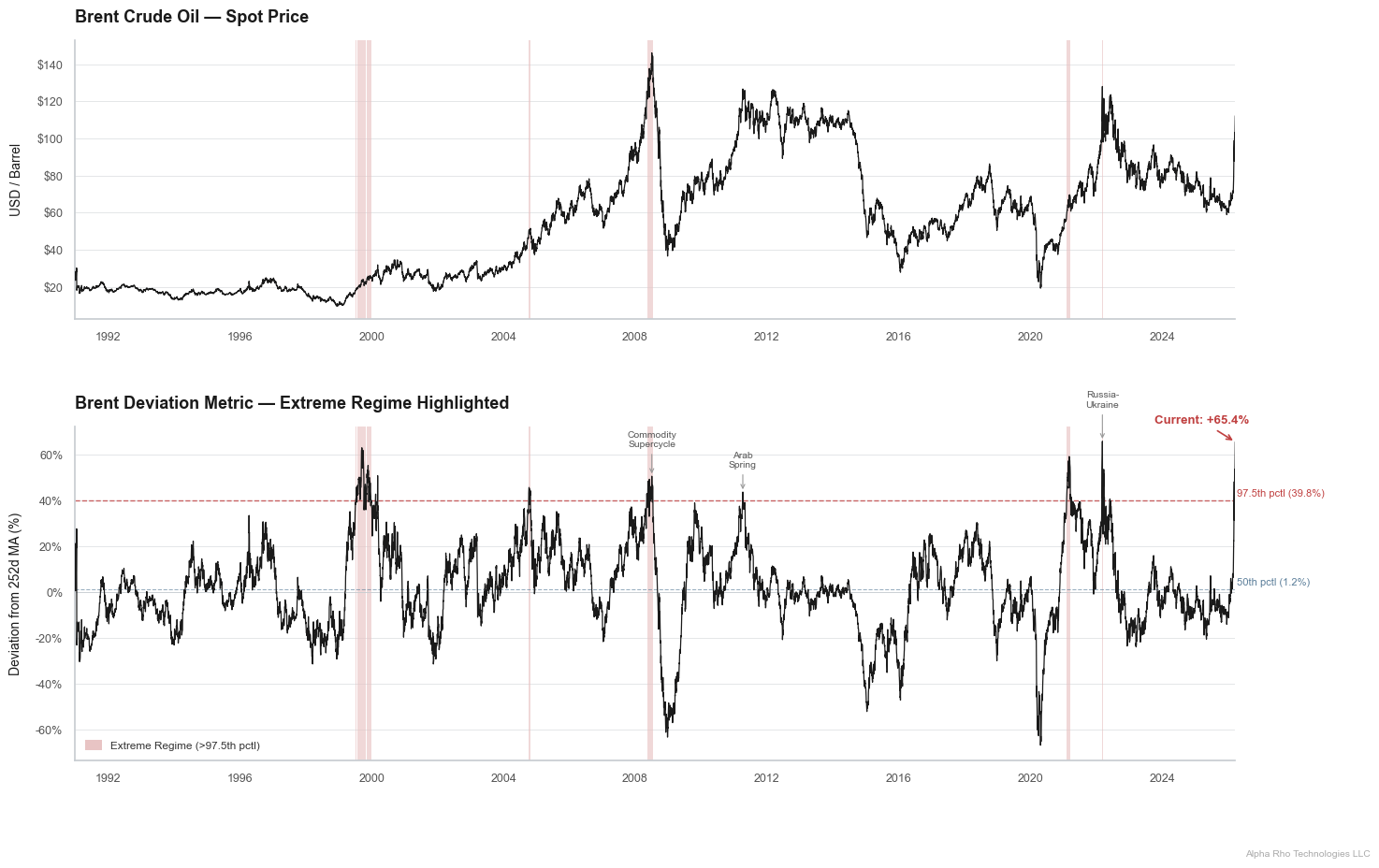
The analysis constructs a Brent crude deviation metric — the percentage gap between Brent’s spot price and its trailing 252-day moving average — computed daily from 1990-12-31 through 2026-03-20 (~9,190 observations). This metric captures how far oil has moved from its own trend, isolating the “shock” component from secular level shifts.
2. Regime Structure
Three regimes are defined using the 50th and 97.5th percentile thresholds of this deviation metric (1.24% and 39.82%):
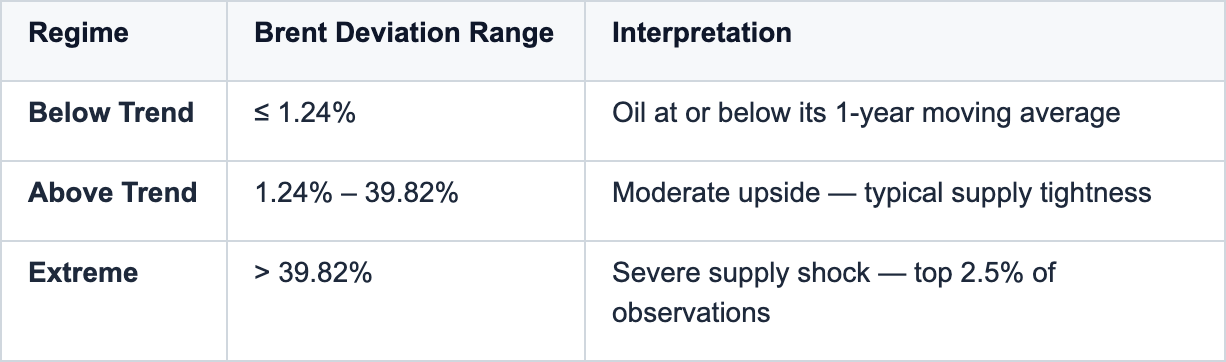
The Extreme regime distribution is built ex-dot-com — all pre-2001 Extreme windows are excluded to avoid contaminating the oil-shock signal with the unrelated tech bubble collapse. The surviving Extreme windows cluster around the 2004 Iraq supply fears, the 2008 commodity supercycle peak, the 2011 Arab Spring spike, the 2021 post-COVID rebound, the 2022 Russia-Ukraine shock, and the current 2026 Hormuz crisis.
3. Regime Transition Matrix
From the Extreme regime, the 252-day forward transition probabilities are:

This means: historically, when Brent is in an Extreme deviation state, one year later it has reverted to Below Trend 29% of the time, settled into Above Trend 58.6% of the time, and remained Extreme only 12.4% of the time. The strong pull toward Above Trend reflects the fact that oil shocks tend to partially normalize but leave a residual premium — prices come off the peak but don’t fully round-trip to trend within a year.
Four duration-weighted conditional distributions blend the three regime return distributions according to how long Extreme conditions persist over the coming 12 months:
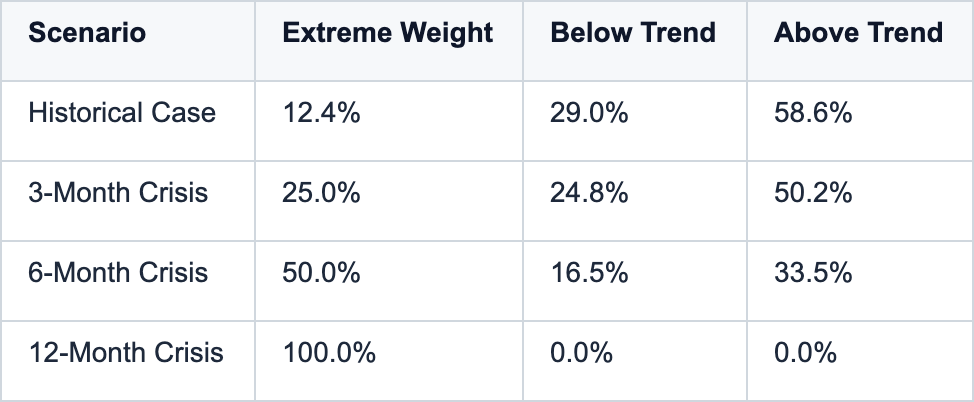
Non-Extreme probability is allocated proportionally to the Below Trend and Above Trend transition shares from the regime’s own 252-day transition matrix.
4. Conditional Distribution Construction
For each of the three regimes, I collect every daily return observed across all 13 dependent assets during the days that regime was active — producing three empirical return pools (Below Trend, Above Trend, and Extreme ex-dot-com). The conditional distribution for a given scenario is constructed by blending these three pools in proportion to the scenario’s assigned regime weights. For the Historical Case, those weights come directly from the 252-day transition matrix row for the Extreme regime (29.0% / 58.6% / 12.4%); for the crisis scenarios, the Extreme weight is manually overridden to reflect the assumed duration (25%, 50%, or 100%), and the remaining probability is redistributed to Below Trend and Above Trend in proportion to their original non-Extreme shares (33.1% / 66.9%). The blend produces a single synthetic return pool of 200,000 daily observations per scenario — effectively a weighted mixture of “what daily returns looked like” under each oil regime.
5. Monte Carlo Simulation
Each scenario’s blended return pool is then bootstrapped via Monte Carlo simulation: 100,000 independent paths are drawn, each 252 trading days long, with daily returns sampled with replacement and compounded to produce a terminal 12-month outcome. The resulting distribution of 100,000 terminal outcomes yields five summary statistics per asset per scenario:
Expected Return — mean of all simulated terminal outcomes
Median — 50th percentile terminal outcome
Bull Case — 90th percentile terminal outcome (optimistic tail)
Bear Case — 10th percentile terminal outcome (adverse tail)
Hit Rate — share of simulated paths ending with a positive 12-month return
Part B — Results: 12-Month Expected Returns by Scenario
In this section, I analyse the four scenarios (quick resolution, 3-month, 6-month, and 12-month crisis), each with explicit geopolitical triggers, resolution conditions, and long/short positioning built from regime-conditioned return distributions.
You will also find an Excel notebook with all the results and scenario returns for auditing purposes or own analysis.
Executive Summary
The four scenarios trace a clear degradation path as crisis duration extends.
