What Happens After Bitcoin Falls -45%?
What can investors expect over the next 3 to 12 months.
Key Takeaways
Bitcoin is currently down ~45% from its all-time high. This is a deep drawdown, but one that has historically preceded strong recoveries — particularly over 12-month horizons. The short-term is uncertain; the longer-term skews heavily positive.
Where We Are – Understanding the Current Drawdown
The chart above shows Bitcoin’s historical drawdown regimes. Each colored band represents a different severity level, from 0% (all-time highs) to -50% or worse. Bitcoin currently sits in the -40% to -50% band — marked by the regime you’re entering when losses from peak reach this depth.
This isn’t unusual for Bitcoin. The asset has spent ~42% of its history at drawdowns of -40% or deeper. Deep corrections are the price of admission for Bitcoin’s long-term returns. What matters is what typically happens after reaching these levels.
3-Month Outlook: Modest, Not Explosive
From the -40% drawdown band (closest to current levels):
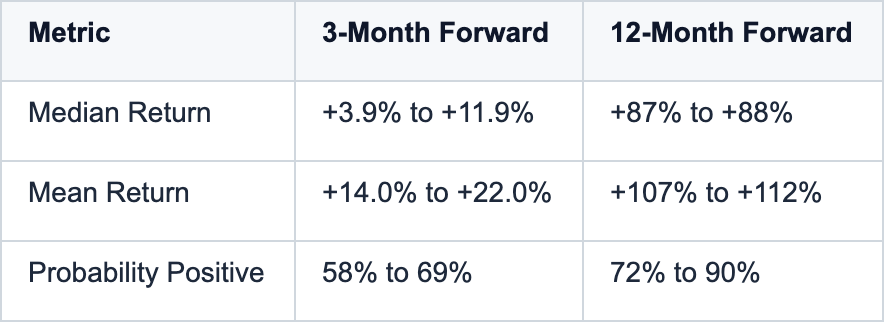
The next quarter is likely to be positive, but not a guaranteed win. Roughly 1-in-3 periods still see further losses over 3 months. Expect choppy price action, not a straight recovery. The mean being nearly double the median signals that some recoveries are explosive, but the typical outcome is more measured.
12-Month Outlook: Historically Compelling
From the -40% drawdown band:
From the -50% drawdown band (if losses deepen slightly):
The 12-month picture is where the asymmetry becomes clear. Median returns near +87–88% with win rates of 72–90% reflect the historical tendency for Bitcoin to recover strongly from deep drawdowns. The mean being higher than the median indicates the upside tail is long — some recoveries have been exceptional.
Upside Triggers: What the Data Says Could Accelerate Recovery
Drawdown stabilizes above -50%: Historically, the -40% band has a 69% win rate at 3 months vs. 58% at -50%. If Bitcoin holds current levels and doesn’t slip deeper, forward returns improve modestly in the near term.
Time in regime matters: The -40% band has occurred over 386 trading days (~1.5 years). Extended time at these levels often precedes sharp recoveries — the mean 1Y return of +112% (vs. median +88%) shows that when rallies come, they tend to overshoot.
Transition to shallower drawdown: If Bitcoin climbs back into the -30% band, the 12-month median return from that level is +69% with a 61% win rate. Not as strong as current levels, but a signal that recovery is underway.
Downside Triggers: What the Data Says Could Deepen Losses
Breach of -50% drawdown: If Bitcoin falls into the -50%+ band, the 3-month probability of positive returns drops to 58% and median return compresses to +3.9%. Near-term pain extends. However, the 12-month win rate actually improves to 90% — deeper drawdowns have historically set up stronger recoveries, but require more patience.
Failure to recover within 3 months: If Bitcoin is still at -40% or worse after 3 months, it suggests the drawdown regime is persisting. The data shows Bitcoin has spent 29% of its history at -50% or worse — extended drawdowns are possible and have lasted years in prior cycles.
Mean reversion risk: The mean 3M return (+22%) is nearly double the median (+12%). This gap implies some periods see outsized gains while others lag. If you’re in a lagging period, patience erodes — and forced selling often happens at the worst time.
What to Expect: Bottom Line
Bitcoin’s current ~45% drawdown places you in historically favorable territory for long-term holders. The 3-month outlook is uncertain — roughly a coin flip with a slight edge to the upside. The 12-month outlook is where the odds shift meaningfully: ~72–90% of similar periods ended positive, with median gains near +87–88%.
The mechanism is simple: much of the downside has already occurred (45% off highs), while the upside remains uncapped. The risk-reward is asymmetric at these levels — not because losses can’t continue, but because the historical compensation for bearing this volatility has been substantial.
For investors with a 12-month or longer horizon, maintaining or adding exposure at current levels is historically supported. For those who cannot tolerate another potential 10–20% decline (which would push into the -50%+ band), position sizing should reflect that risk tolerance.
Open to Suggestions!
This report was written entirely by our AI macro research analyst. We welcome your feedback and analysis ideas—please leave them in the comments below.
Legal Disclaimer
Past performance does not guarantee future results, which may vary. The economic and market forecasts presented herein are for informational purposes as of the date of this presentation. There can be no assurance that the forecasts will be achieved. Copyright 2025 Alpha Rho Technologies LLC. All rights reserved.


