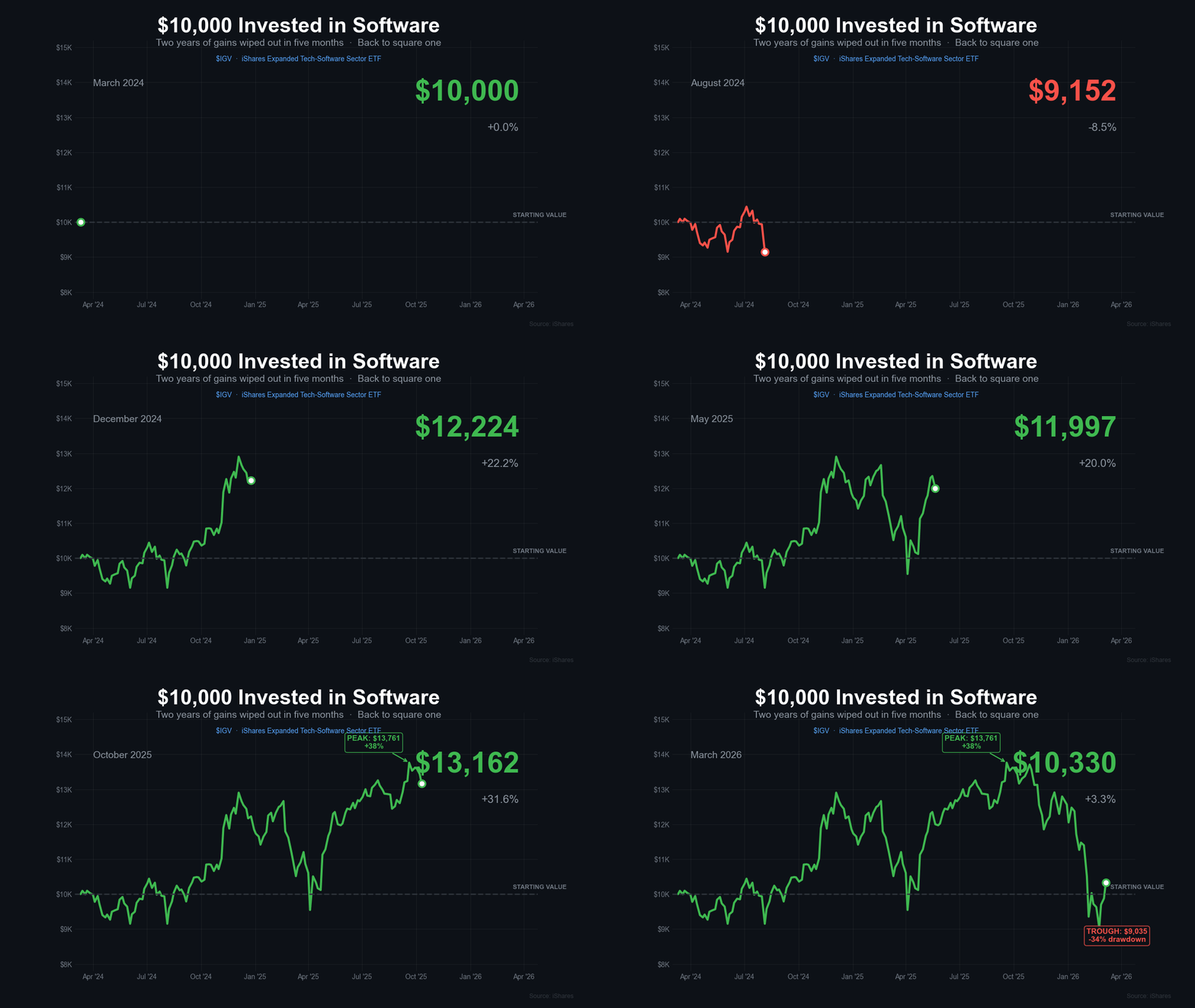
This analysis uses iShares Expanded Tech-Software Sector ETF (IGV) to analyse US software sector performance.
Executive Summary
Drawdown Regime: IGV’s -34.7% trough depth places it in severe bear territory—exceeded only by dot-com, GFC, and 2022. Historical analogs imply 3+ years to full recovery, not quarters.
Fundamental Drivers: Three structural forces compress multiples: 10Y at 4.12% despite 175bps of Fed cuts (duration trap); $450B AI capex redirecting $25–40B annually from SaaS procurement; NRR compression from 125%+ to 107–115%. Current valuation: 6.2x forward revenue vs. 9.8x 5-year median.
Upside Catalyst: +18% IGV return if 10Y falls 100bps. Transmission has failed this cycle—May 2026 Fed Chair transition (Powell term expiry) creates discrete catalyst window via dovish policy shift expectations. Probability-weighted 3-month return: +5.6%.
Downside Catalyst: NRR <100% is the exit signal. Systems of record (CRM, WDAY, NOW—35% of IGV) retain pricing power; workflow applications face 8–15% AI cannibalization headwind. Mild IT deceleration implies $72–78 (-16%); severe implies $58–65 (-32%).
Current Drawdown Regime Characterization
Takeaway: IGV’s -34.7% trough depth classifies this as a severe bear episode—recovery takes years, not quarters.
IGV peaked at $117.79 on September 22, 2025, and now trades at $85.65 (−27.3% from peak). The intra-episode trough reached −34.7% on February 23, 2026. At 121 trading days, duration exceeds the median correction by 3x.
This isn’t a correction. The −30% threshold separates cyclical corrections from structural drawdowns—only dot-com (−62%), GFC (−50%), and the 2022 cycle (−46%) have exceeded the current trough depth.
The current episode slots into the severe bear cohort. Average recovery time for this classification: 4.2 years. If historical analogs hold, base case recovery is late 2028 at earliest—assuming no further macro deterioration, earnings growth stabilizes at mid-to-high single digits, and multiples hold current levels.
Key risk: duration extension. The 2001–2007 episode required 6+ years because starting valuations were structurally impaired. If current multiples embed similar froth, recovery extends to 2029–2030.
Fundamental Drivers Behind the Move
Takeaway: Three structural forces—not cyclical dislocations—are compressing multiples: elevated long rates, AI capex cannibalization, and deteriorating NRR. IGV currently trades at 6.2x forward revenue versus its 5-year median of 9.8x.
Rate Regime: Duration Trap
The Fed has cut 175bps since September 2024. The 10-year Treasury sits at 4.12%—essentially unchanged from IGV’s peak. Front-end easing hasn’t transmitted to long rates. Software multiples are levered to the discount rate applied to distant cash flows; a company at 25x revenue with 70% of value beyond year 5 loses 15–20% of intrinsic value when discount rates rise 100bps. Rates don’t need to rise further—they just need to stay elevated.
The IGV drawdown accelerated precisely when fed funds futures repriced from four 2026 cuts to one or none.
AI Capex Cannibalization
The five largest US cloud/AI providers committed $660–690 billion in 2026 capex, nearly doubling 2025. Approximately 75% (~$450B) funds AI infrastructure. This isn’t additive spend—dollars that would have flowed to traditional SaaS seats are redirected to GPUs, model training, and inference.
Revenue impact on IGV constituents: workflow-layer software (horizontal SaaS tools, analytics platforms, collaboration suites) faces 8–15% revenue pressure as AI agents substitute for seat-based licenses. Systems of record (Salesforce, Workday, ServiceNow—~35% of IGV weight) retain pricing power with 3–5% headwind. Net effect: $450B AI capex redirects an estimated $25–40B annually away from traditional software procurement across the enterprise stack.
IT budget growth decelerates to 3.4% in 2026, but internally the shift is dramatic: funds reallocate from application software to AI infrastructure. Enterprise CIOs renegotiate SaaS contracts while expanding AI pilot budgets.
NRR Compression
Enterprise NRR has declined from 130%+ peaks to 107–118% currently. The median company with ≥100% NRR grows at 48% YoY—double the speed of lower-NRR cohorts. As NRR compresses, organic growth engines weaken, forcing higher customer acquisition spend that compresses margins and growth simultaneously.
SaaS revenue multiples collapsed from ~18x at the 2021 peak to 5–6x today—a 70% contraction. The 2022 drawdown was a pure duration event. The 2025–2026 drawdown layers AI disruption risk onto rate sensitivity—higher discount rates and lower terminal growth assumptions simultaneously.
Upside Catalyst: Fed Pivot and Multiple Re-Rating
Takeaway: The rate catalyst exists but hasn’t fired—transmission from front-end easing to long rates has been negative this cycle. The May 2026 Fed Chair transition creates a discrete catalyst window.
Historical Rate Sensitivity
When the 10-year falls 50–100bps over three months, IGV delivers +9.8% median returns with 85.6% probability of positive performance. When rates decline >100bps, median return jumps to +17.8% with 92.8% hit rate. The combined scenario—Fed cutting 75bps+ AND 10-year falling 50bps+—produces +14.6% mean 3-month returns.
Why Transmission Has Failed
The 2024–2026 cycle shows negative transmission: Fed cut 175bps, the 10-year rose 6bps. Prior cycles showed 30–50% transmission. The Fed’s credibility gap is the blocker—inflation above 2% for four years keeps term premium elevated.
May 2026 Fed Chair Transition: The Catalyst Mechanism
Powell’s term expires May 2026. A dovish successor—or even credible signaling of one—would shift the SEP dot plot lower and compress term premium. The mechanism: markets currently price persistent hawkishness into the long end; a leadership transition signals regime change in the reaction function. If the incoming Chair emphasizes employment over inflation (plausible given political pressure), the 10Y could compress 50–75bps within 3–6 months of appointment clarity. This is the discrete event that breaks the transmission failure.
Trigger Conditions (Probability-Weighted)
Scenario Matrix
Probability-weighted expected return: +5.6% over three months. The upside skew is notable: if the catalyst fires, IGV captures half the drawdown recovery in a single quarter.
Confidence interval on $104–110 target: Achievable within 12–18 months if 10Y falls to 3.50% (15–20% multiple expansion) + 10–12% earnings growth. Downside to this target: transmission failure extends, range stays $88–95.
Downside Catalyst: Enterprise Spending Deterioration
Takeaway: The tail risk is NRR breaching 100% as AI agents cannibalize seat-based revenue—a scenario that transforms software from compounding asset to melting ice cube.
Trigger: Anticipation of Recession
Enterprise IT procurement operates on 6–12 month planning cycles. If CIOs expect 2027 budget pressure, they freeze discretionary spend in mid-2026. The Q2–Q3 2025 “uncertainty pause” compressed billings growth 300–500bps even without actual budget cuts. If macro deteriorates, the pause extends.
Historical sensitivity: 5% IT budget cut → 8–12% software revenue miss.
AI Cannibalization Mechanism
AI agents are “10x faster, 100x smarter” than junior staff—directly cannibalizing seat-based revenue. If an AI agent replaces three junior analysts using Salesforce seats, that’s three fewer licenses renewed. Systems of record (Salesforce, Workday, ServiceNow) retain defensibility, but workflow applications face direct substitution risk.
Leading Indicators
Downside Scenarios
Confidence interval on $58–65 downside: Requires severe deceleration (growth to 3–6%, multiples to 4x). This matches 2022 trough depth. Probability: 15%. Below $55 requires outright recession—10% probability.
Bottom Line
The -27% drawdown has repriced IGV for legitimate structural headwinds—not a temporary dislocation. Three forces converged: rates that refused to fall despite 175bps of Fed cuts, AI capex redirecting enterprise dollars away from traditional SaaS, and NRR compression eroding organic growth engines. Multiples contracted from 12x to 6x; growth expectations reset from 25% to 12%. The repricing is rational.
What The Market Is Pricing
Current valuation (6.2x forward revenue vs. 9.8x 5-year median) embeds:
Persistently elevated discount rates through 2026
Mid-single-digit revenue growth (down from mid-teens expectations)
Modest margin expansion as companies prioritize profitability over growth
The market is not pricing a recession. It is not pricing NRR breaching 100%. It is pricing a slower, more capital-efficient software sector—one where AI is a headwind to seat-based revenue, not a tailwind to growth.
Key Variables To Monitor
For Improvement:
10Y Treasury breaking below 3.75% with Fed signaling completion of cutting cycle
NRR stabilizing above 110% for two consecutive quarters across bellwethers
AI monetization inflecting from cost center to revenue driver at scale
For Deterioration:
Billings deceleration >500bps without macro explanation
Multiple bellwethers citing “AI optimization” or “seat consolidation” as headwinds
NRR breaching 100% at two or more of Salesforce, ServiceNow, Workday
The Core Question
This isn’t about whether software is “cheap” or “expensive.” It’s about whether the structural headwinds—rate sensitivity, AI cannibalization, NRR compression—are fully priced or still unfolding. The evidence suggests the market has discounted the known risks. The unknown risk is whether AI cannibalization accelerates faster than AI monetization—a question that won’t be answered until late 2026 earnings cycles provide clarity on enterprise AI adoption patterns.
Open to Suggestions!
This report was written entirely by our AI macro research analyst. We welcome your feedback and analysis ideas—please leave them in the comments below.
Legal Disclaimer
Past performance does not guarantee future results, which may vary. The economic and market forecasts presented herein are for informational purposes as of the date of this presentation. There can be no assurance that the forecasts will be achieved. Copyright 2025 Alpha Rho Technologies LLC. All rights reserved.


