


Executive Summary
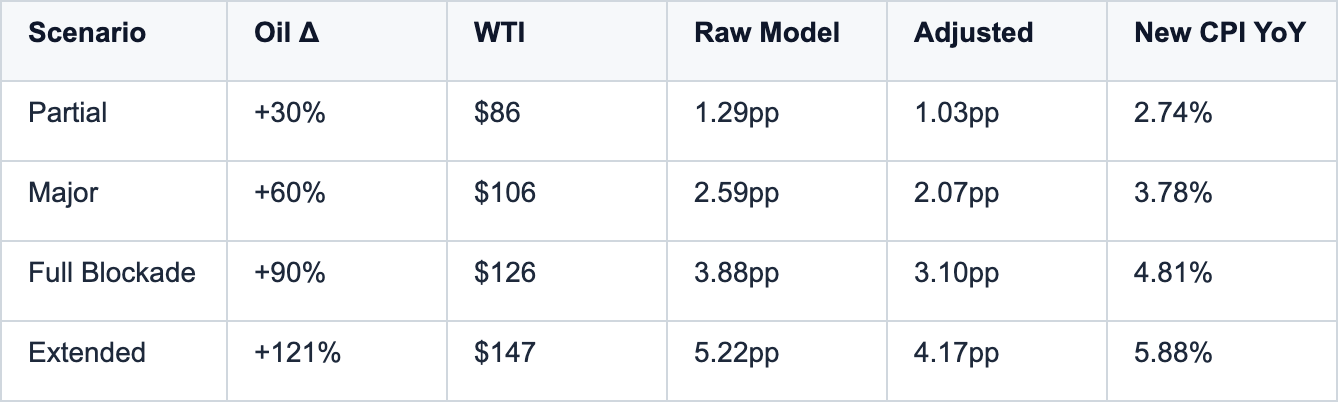
Oil Shock Scenarios and CPI Impact: The Strait of Hormuz is the world’s most critical energy chokepoint; disruption scenarios range from +30% oil ($86 WTI, +1.05pp CPI) to +121% ($146 WTI, +4.20pp CPI). A full blockade would raise consumer prices roughly as much as in early 2022. Full passthrough takes 6–12 months, but equity markets typically re-price within 2–4 weeks of a 20%+ oil spike—front-running realized inflation prints.
S&P 500 Returns Under Inflation Scenarios: Analysis of 1990–2025 data shows the 3% CPI threshold is the critical breakpoint—below it, expected 1-year returns run 13–16% with 88–91% win rates; above it, returns collapse to 3.4% with 65% win rate. Current CPI at 1.71% (Q2 regime) implies +13% expected return. A Major Disruption (+60% oil to $106/bbl) pushes CPI to 3.81%, breaching this threshold and cutting expected returns by nearly 10 percentage points.
Bottom Line: The market is pricing disinflation continuation—a supply shock breaks this narrative. Monitor WTI and 5-year TIPS breakevens as leading indicators. Partial disruptions are absorbable; major disruptions trigger regime shift and materially degrade equity risk-reward.
Oil Shock Scenarios and CPI Impact
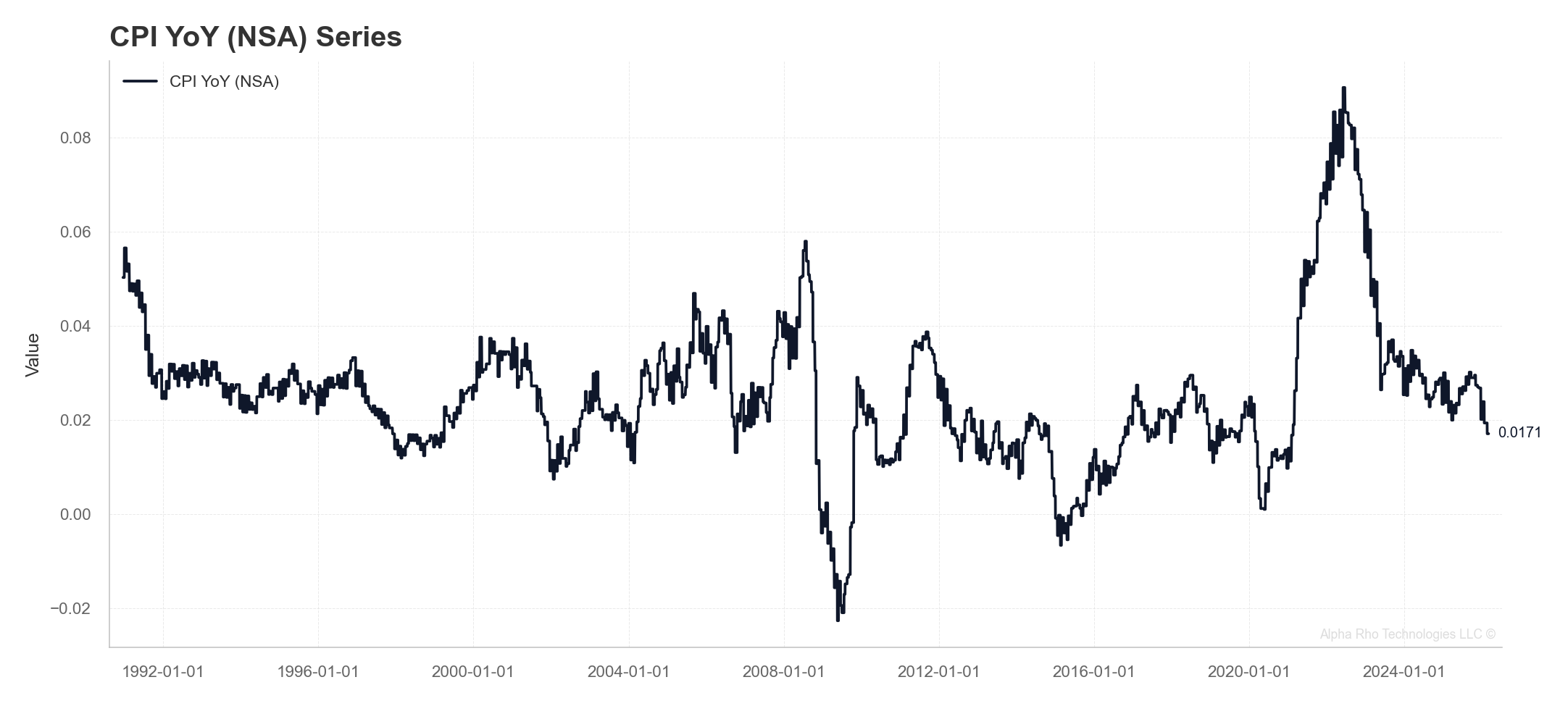
The chart shows CPI YoY inflation from 1990–2026. Current reading: 1.71%—the lowest in over a year. This is the baseline from which any Hormuz shock would propagate.
Strait of Hormuz Disruption: Oil-to-CPI Transmission Scenarios
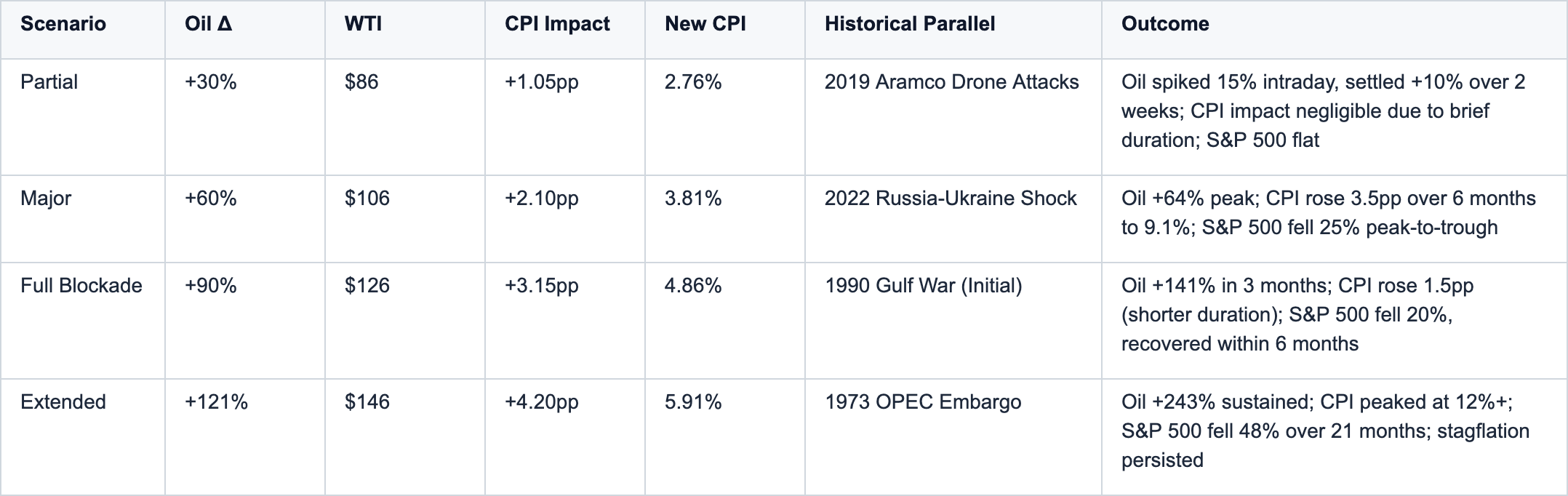
Key insight from historical parallels: Duration matters as much as magnitude. The 1990 Gulf War saw a larger oil spike than 2022 Russia-Ukraine (+141% vs +64%), but the CPI impact was smaller (1.5pp vs 3.5pp) because the supply disruption resolved within months. The 1973 embargo’s prolonged duration drove the most severe inflation and equity drawdowns. A Hormuz blockade’s duration—not just initial price spike—will determine ultimate market impact.
The Strait of Hormuz functions as the world’s most critical energy chokepoint. Any disruption transmits to consumer prices through four channels: direct energy costs (gasoline, utilities, heating) account for 50–60% of the CPI impact; transportation costs add 10–15% as freight and shipping adjust; producer input costs (chemicals, plastics, agriculture) contribute 15–20%; and services passthrough (airfares, delivery, hospitality) rounds out the remaining 10–15%.
Timing matters: Full CPI passthrough takes 6–12 months, but equity markets typically re-price within 2–4 weeks of a 20%+ oil spike—front-running the inflation prints.
S&P 500 Returns Under Inflation Scenarios
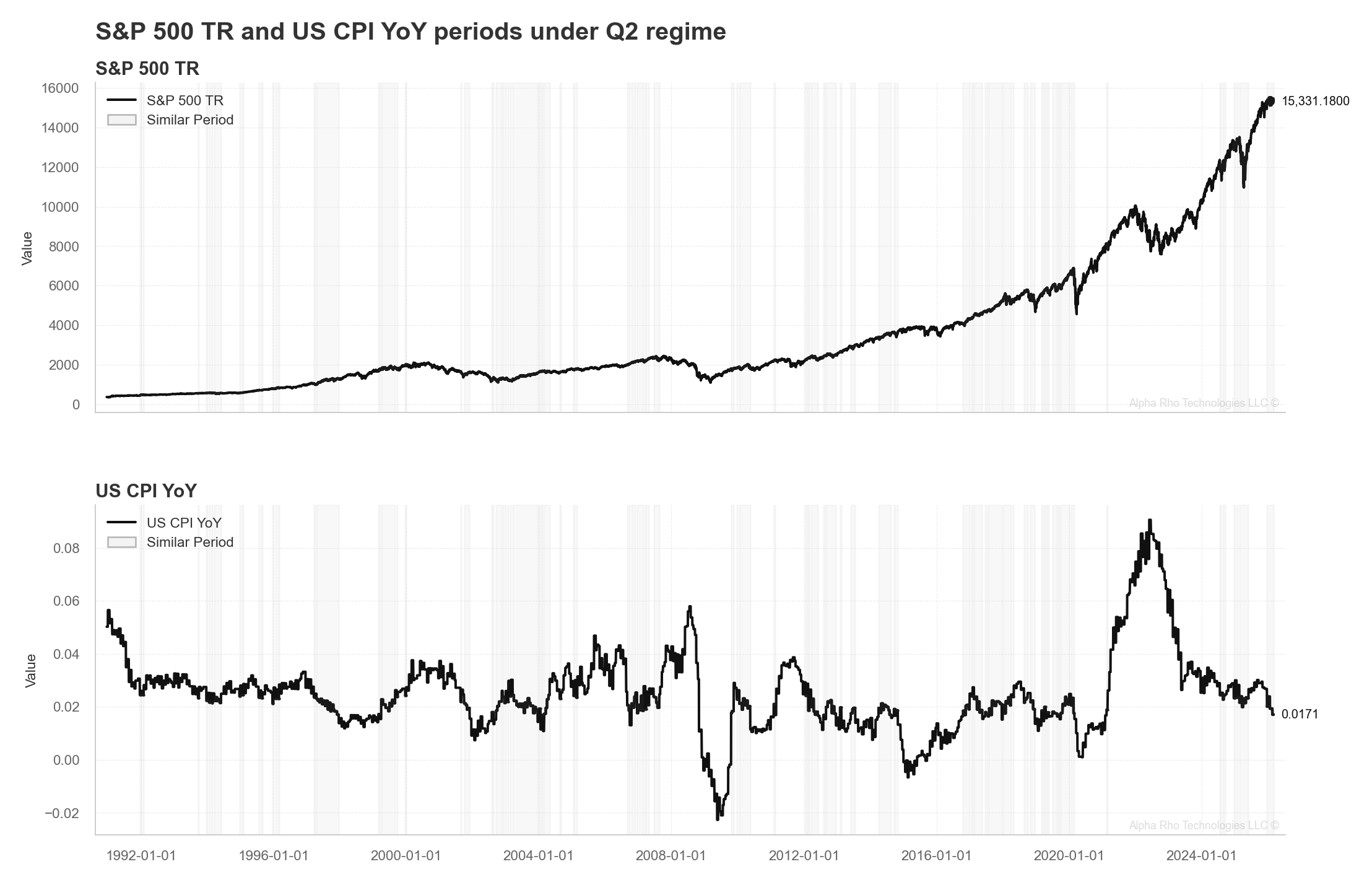
The 3% CPI threshold operates as the critical breakpoint for equity returns. When CPI YoY runs below 3.06% (Q1–Q3 regimes), the S&P 500 delivers mean 1-year returns of 13–16% with win rates of 88–91%. Above 3% (Q4 regime), mean returns collapse to 3.4% with a 65% win rate—a dramatic compression in both magnitude and consistency.
Integrated Scenario Analysis: From Oil Shock to Equity Returns
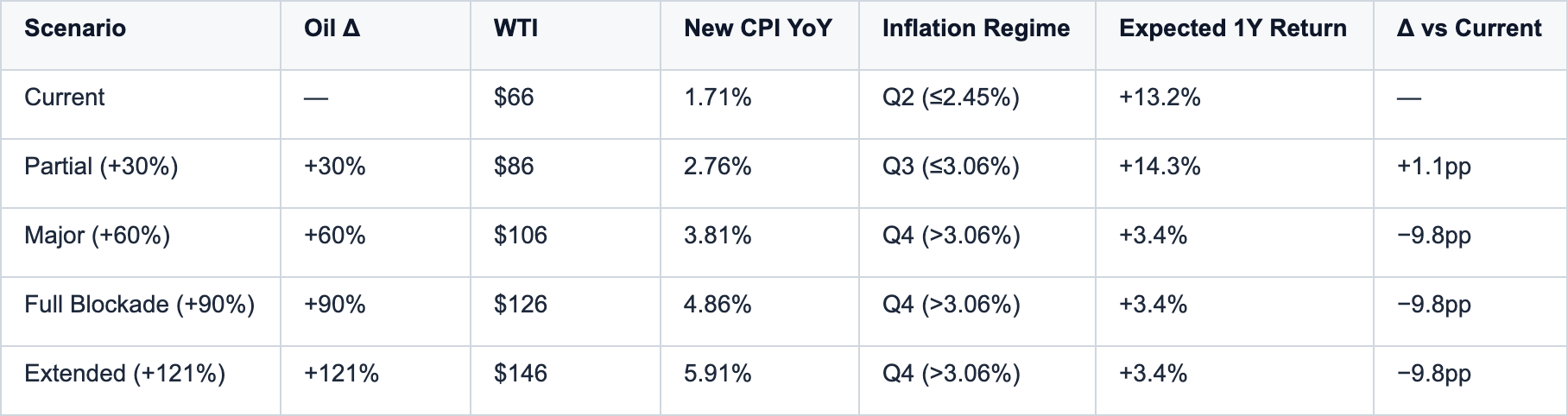
The Major Disruption scenario (+60% oil, 3.81% CPI) represents the tipping point. At 2.76% inflation from a Partial Disruption, the S&P 500 remains in Q3 where historical returns run slightly higher at 14.3% mean. But the jump to 3.81% triggers regime shift into Q4—where expected returns drop by nearly 10 percentage points and win rate falls from 88% to 65%.
This non-linear payoff structure means markets should price Hormuz risk asymmetrically: the first 30% oil move is absorbable, but the incremental move beyond that triggers regime shift and materially degrades equity forward returns.
Bottom Line
Current positioning is favorable. With CPI at 1.71%, the S&P 500 sits in the Q2 inflation regime where history delivers 13.2% median 1-year returns with a 91% win rate. The disinflation trend that began in mid-2022 has pushed realized inflation to levels that historically support sustained equity performance.
The 3% CPI threshold is the line in the sand. Below it, equity returns cluster in the 13–16% range with near-90% reliability. Above it, expected returns collapse to 3.4% with a 65% win rate. A Major Hormuz disruption (+60% oil to $106) is the scenario that breaches this threshold.
Historical parallels reinforce the framework: the 2022 Russia-Ukraine shock (+64% oil, CPI to 9.1%) saw the S&P 500 fall 25%. The 1973 embargo (+243% oil, CPI to 12%+) delivered a 48% drawdown over 21 months. Duration and magnitude both matter—but the 3% CPI threshold consistently marks where equity risk-reward deteriorates.
The market is pricing disinflation continuation. Any break in this narrative triggers repricing in rates, equities, and the dollar—typically within 2–4 weeks of a major oil spike. The actionable framework: monitor WTI spot prices and 5-year TIPS breakevens for early warning. Once CPI crosses 3%, the equity risk-reward profile degrades materially regardless of how far above the threshold inflation runs.
Open to Suggestions!
This report was written entirely by our AI macro research analyst. We welcome your feedback and analysis ideas—please leave them in the comments below.
Legal Disclaimer
Past performance does not guarantee future results, which may vary. The economic and market forecasts presented herein are for informational purposes as of the date of this presentation. There can be no assurance that the forecasts will be achieved. Copyright 2025 Alpha Rho Technologies LLC. All rights reserved.
Oil-to-CPI Transmission Model: Calculation Methodology
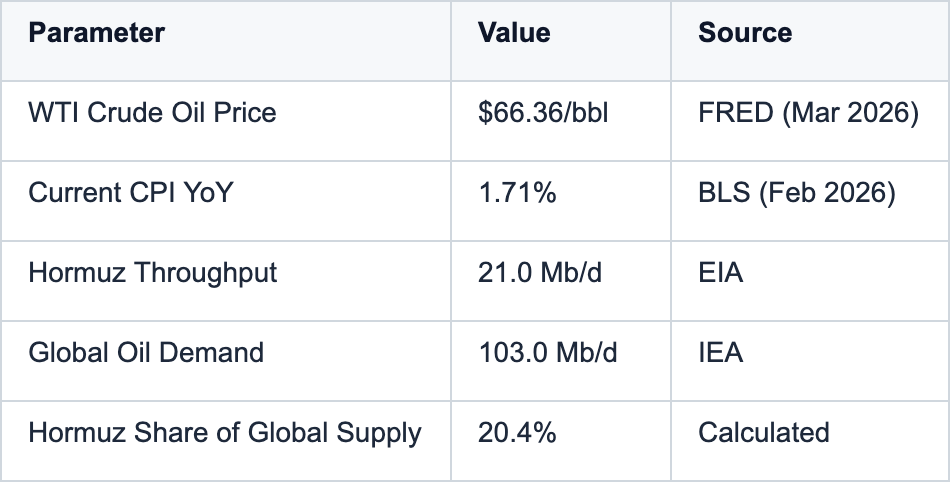
1. Baseline Conditions
2. Oil Price Shock Scenarios
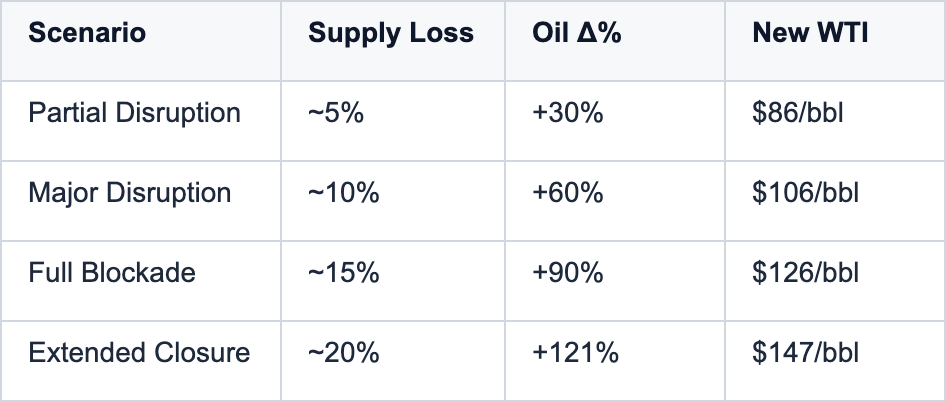
Oil price elasticity to supply shocks: approximately 6x. A 5% supply loss generates ~30% price increase; non-linear amplification at extremes.
3. CPI Component Weights (BLS 2024-2025)
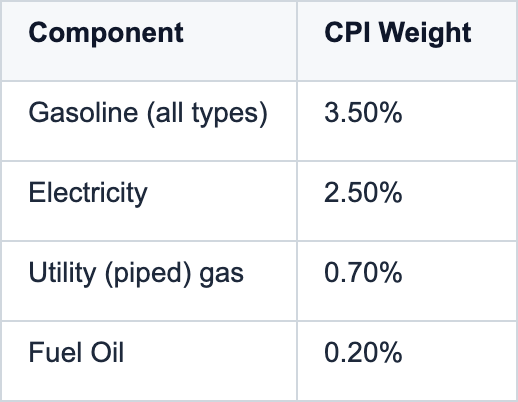
Direct Energy Components (6.90% of CPI)
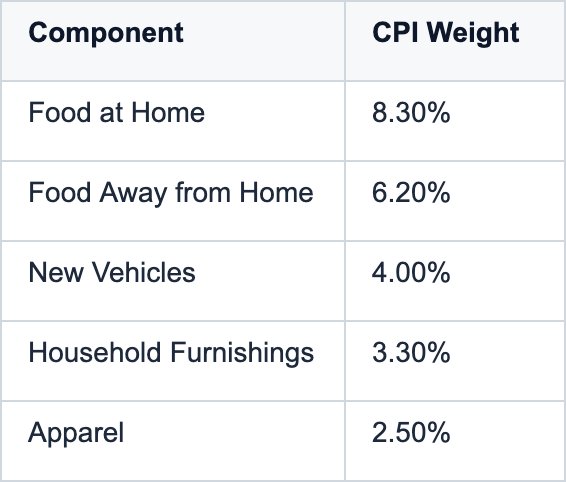
Indirect Energy-Sensitive Components
4. Channel 1: Direct Energy Impact
Transmission: Oil → Retail Energy Prices → CPI
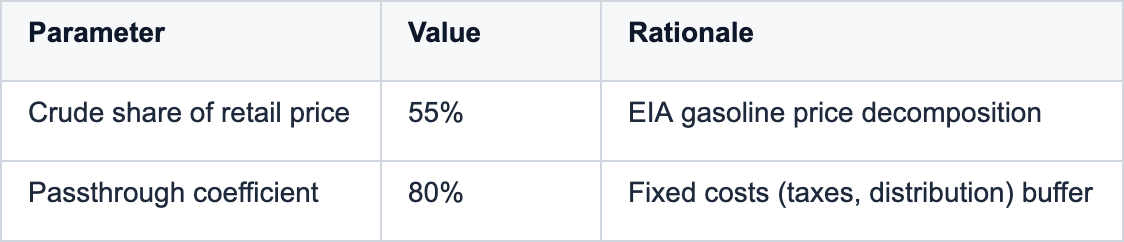
Gasoline (CPI weight: 3.50%)
```
Retail price Δ = Oil Δ% × Crude Share × Passthrough
= 60% × 55% × 80% = 26.4%
CPI contribution = Retail Δ × CPI Weight
= 26.4% × 3.50% = +0.92pp
```
Fuel Oil (CPI weight: 0.20%)
CPI contribution = 60% × 70% × 85% × 0.20% = +0.07pp
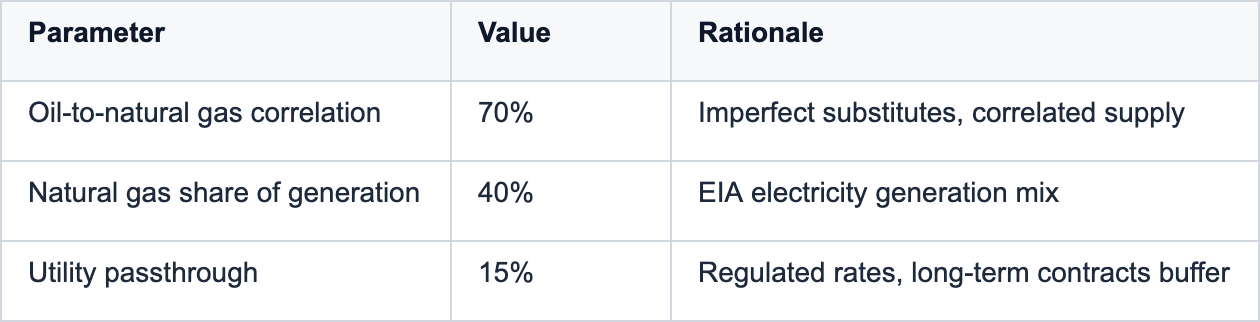
Electricity (CPI weight: 2.50%)
```
Effective Δ = Oil Δ × Gas correlation × Gas share × Utility passthrough
= 60% × 70% × 40% × 15% = 2.5%
CPI contribution = 2.5% × 2.50% = +0.06pp
```
Utility Gas (CPI weight: 0.70%)
CPI contribution = 60% × 70% × 60% × 0.70% = +0.18pp
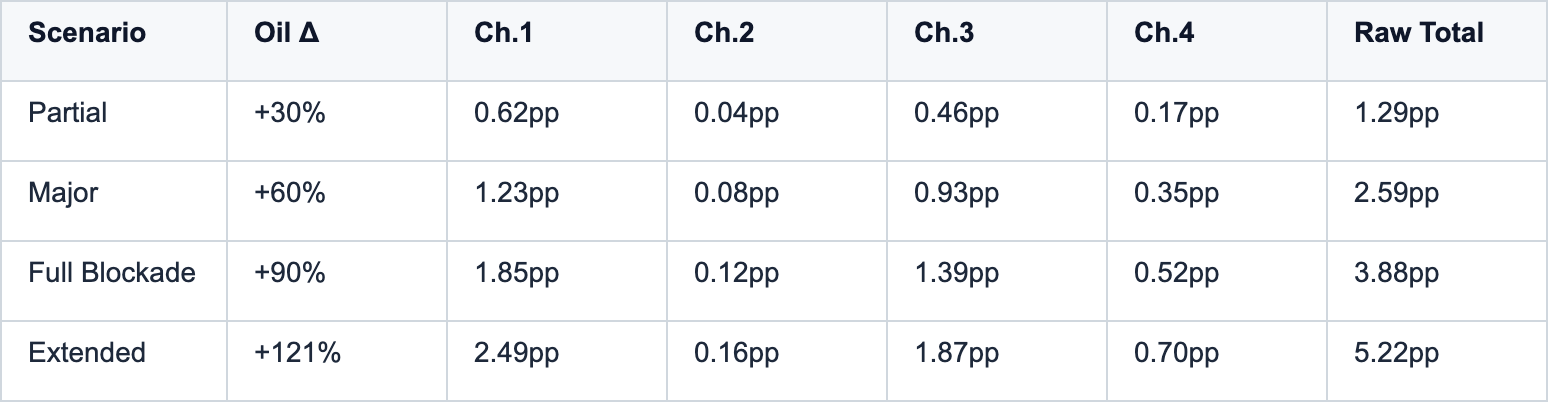
Channel 1 Total (Major Disruption): +1.23pp
5. Channel 2: Transportation/Logistics Impact
Transmission: Oil → Diesel → Trucking Costs → Goods Prices → CPI
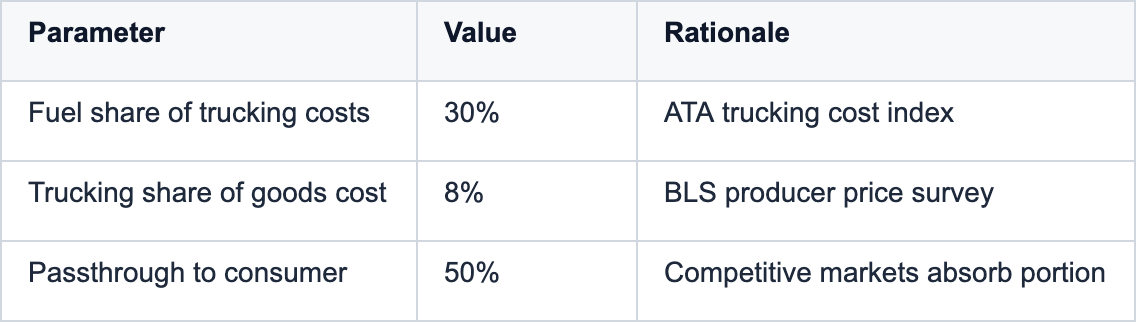
Step 1: Diesel Δ = Oil Δ × Crude share × Passthrough
= 60% × 60% × 85% = 30.6%Step 2: Trucking cost Δ = Diesel Δ × Fuel share of trucking
= 30.6% × 30% = 9.2%Step 3: Goods cost Δ = Trucking Δ × Trucking share of goods
= 9.2% × 8% = 0.73%Step 4: CPI contribution = Goods Δ × Goods weight × Passthrough
= 0.73% × 21% × 50% = +0.08pp
Channel 2 Total (Major Disruption): +0.08pp
6. Channel 3: Producer Input Costs
Transmission: Oil → Feedstock/Energy Costs → PPI → CPI
Food Production Inputs
Energy-sensitive share of food costs:
Fertilizer (nitrogen from natural gas): ~4%
Farm equipment fuel: ~3%
Food processing energy: ~2%
Refrigeration/cold chain: ~1%
Total: ~10%
CPI contribution = Oil Δ × Sensitivity × Passthrough × Food weight
                = 60% × 10% × 60% × 14.5% = +0.52pp
Non-Food Goods Inputs
Energy-sensitive share of goods costs:
Petrochemical feedstocks: ~3%
Packaging materials: ~2%
Manufacturing energy: ~3%
Total: ~8%
CPI contribution = 60% × 8% × 40% × 21.0% = +0.40pp
Channel 3 Total (Major Disruption): +0.93pp
7. Channel 4: Services Passthrough
Transmission: Oil → Operating Costs → Service Prices → CPI
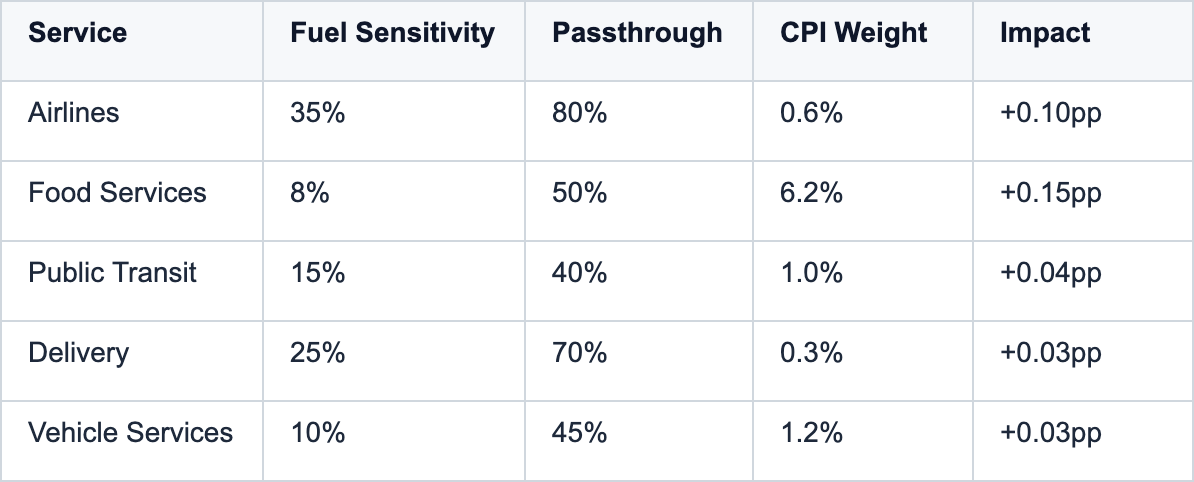
Channel 4 Total (Major Disruption): +0.35pp
8. Consolidated Model Output
Channel Contribution (% of Total)
Channel 1 (Direct Energy): 48%
Channel 3 (Producer Inputs): 36%
Channel 4 (Services): 14%
Channel 2 (Transportation): 3%
9. Historical Calibration
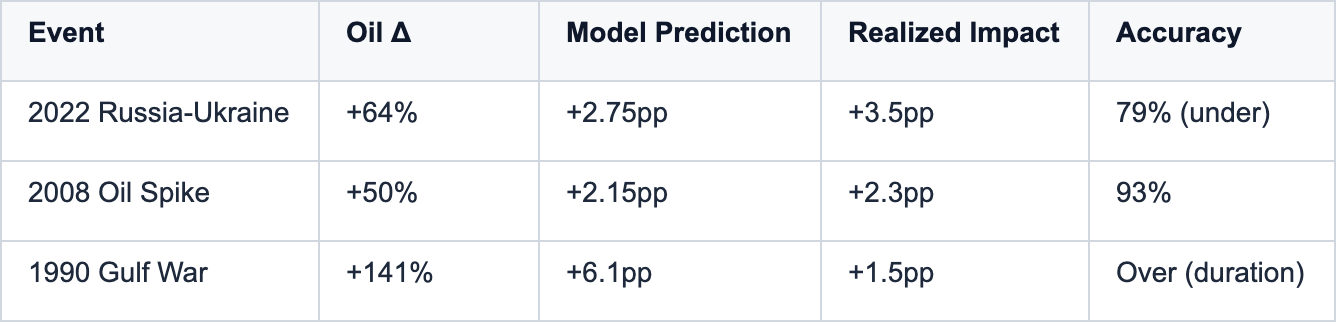
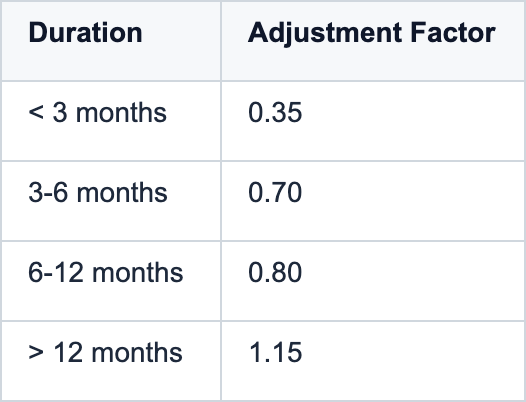
Key insight: Duration determines realized impact. The 1990 Gulf War saw a larger oil spike than 2022 (+141% vs +64%), but lower CPI impact (1.5pp vs 3.5pp) because the shock resolved in 3 months vs 6+ months.
Duration Adjustment Factors
10. Final Duration-Adjusted Estimates
Assuming 6-12 month disruption (80% adjustment factor):
11. Formula Reference Card
Master Formula
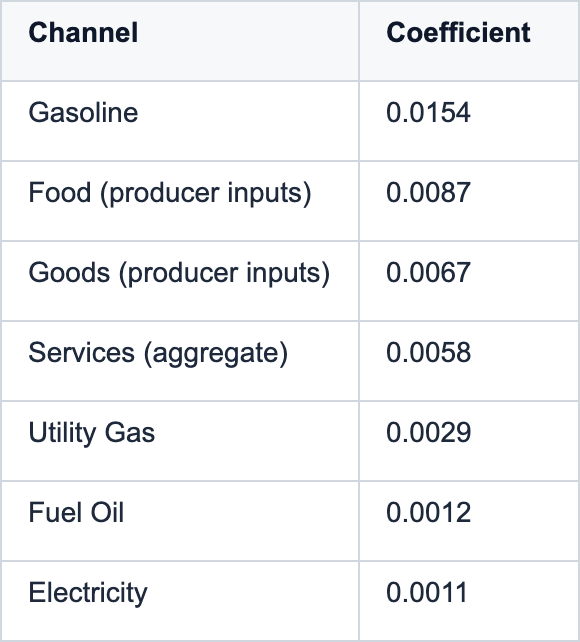
CPI Impact (pp) = Σ [ Oil Δ% × Sensitivity × Passthrough × CPI Weight ]
Quick Estimate Formula
CPI Impact ≈ Oil Δ% × 0.043 × Duration Adjustment
Example: +60% oil shock, 6-12 month duration:
CPI Impact ≈ 60 × 0.043 × 0.80 = 2.06pp ✓
Channel Coefficients (multiply by Oil Δ%)
Model Limitations
Assumes no Fed response: Aggressive rate hikes would dampen goods/services passthrough
Linear within channels: Non-linearities at extreme oil prices not captured
No demand destruction: Assumes consumers don’t substitute away from energy
Single-country focus: US CPI weights; other economies differ
No SPR release: Strategic Petroleum Reserve deployment would reduce oil Δ by 10-15pp