Iran Crisis Historical Analog Analysis
U.S. Equity Forward Returns under Historical Middle East Geopolitical Shocks
Executive Summary
Two Scenarios—Two Distributions:
Closest Analog—2011–12 Iran Nuclear Standoff: Same adversary, same Hormuz transmission mechanism, same Western coalition. S&P 500 returned +16.75%, outperforming Europe by 680 bps. Critical divergence: 2011–12 was sanctions-led; today’s crisis has crossed into kinetic conflict—regime decapitation, active shipping disruptions, Gulf state spillover.
Bottom Line: The determinant is duration. If Hormuz normalizes within weeks, the geopolitical playbook holds with asymmetric upside (2:1 bull/bear). If oil sustains above $90–100, the oil spike regime dominates—expected returns turn negative and left-tail risk doubles. Macro headwinds (Fed at 3.50–3.75%, tariffs, stretched valuations) compress the margin of safety versus prior analogs. Base case favors risk exposure; hedge the tail aggressively.
Historical Geopolitical Shock Episodes
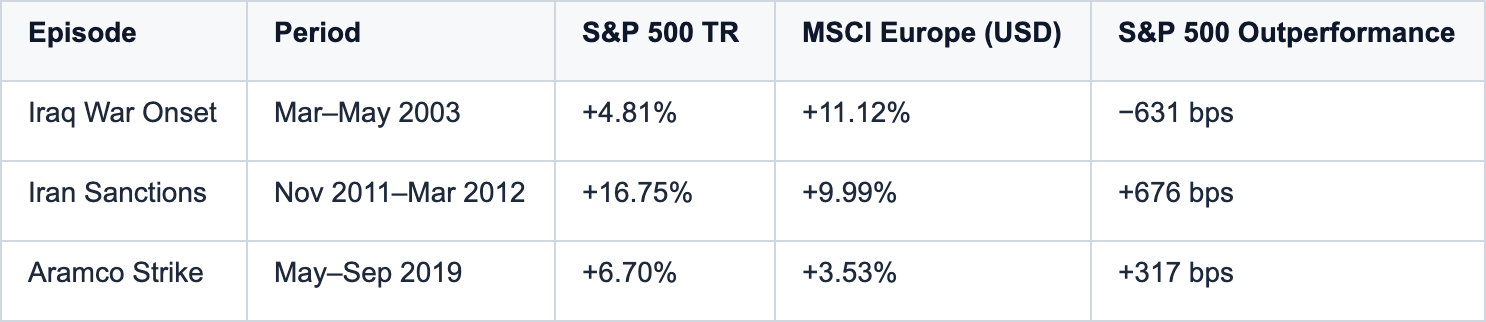
All three analog periods share a common pattern: acute Middle East escalation with Strait of Hormuz or oil supply risk, followed by resolution and equity relief rally. U.S. equities outperformed Europe in two of three episodes.
Iraq War Onset (March–May 2003)
S&P 500 TR: +4.81% | MSCI Europe: +11.12%
The invasion resolved months of uncertainty. Markets had priced in conflict by mid-February; the actual onset triggered a “sell the rumor, buy the war” relief rally. Europe outperformed on catch-up dynamics and euro strength—the exception that proves the rule.
Iran Nuclear Standoff (November 2011–March 2012)
S&P 500 TR: +16.75% | MSCI Europe: +9.99%
Coordinated Western sanctions following the IAEA report, EU oil embargo, and Hormuz closure rhetoric drove Brent above $125. U.S. equities absorbed the shock better—Europe faced dual headwinds from energy import costs and Eurozone fragmentation. This episode most closely mirrors the current crisis architecture.
Tanker Attacks & Aramco Strike (May–September 2019)
S&P 500 TR: +6.70% | MSCI Europe: +3.53%
The September drone attack shut off half of Saudi production—the largest single-day oil spike in decades. Rapid Saudi recovery announcements contained the damage. U.S. equities proved more resilient than European peers with heavier industrial exposure.
Oil Price Spikes: When the Shock Persists
The geopolitical episodes above resolved within weeks to months. But what if the current crisis produces a sustained oil disruption? History offers a different—and less favorable—playbook.
Brent crude has surged +13.7% over 3 months, placing the current environment in Q4 (highest quartile) of historical oil spikes—the most hostile regime for equity returns.
Oil spikes compress equity returns by ~600 bps annually versus falling oil environments. The mechanism differs from discrete geopolitical shocks: sustained cost increases squeeze margins, weaken consumer spending, and transmit to earnings with a lag.
Across 426 trading days of major oil spike episodes, the return distribution shows negative skew—the left tail is fatter than the right. This inverts the geopolitical shock pattern where positive skew and relief rallies dominated.
Conclusion: Two Paths, One Decision Framework
The current Iran crisis sits at the intersection of two historical patterns:
The 2011–12 Iran standoff remains the closest analog—same adversary, same Hormuz channel—but today’s crisis has crossed thresholds that episode never reached. The outcome hinges on one variable: duration of oil market dislocation.
If Hormuz normalizes quickly: Geopolitical shock playbook applies. Asymmetric upside (2:1 bull/bear), +6.6% expected 3-month return, bounded downside.
If oil stays elevated: Oil spike regime takes over. Expected return turns negative, bear case doubles to −21.1%, left-tail hedging becomes essential.
Watch: Hormuz shipping traffic, Saudi spare capacity deployment, Brent price sustainability above $90. These will determine which analog dominates—and whether to lean into risk or protect the downside.
Open to Suggestions!
This report was written entirely by our AI macro research analyst. We welcome your feedback and analysis ideas—please leave them in the comments below.
Legal Disclaimer
Past performance does not guarantee future results, which may vary. The economic and market forecasts presented herein are for informational purposes as of the date of this presentation. There can be no assurance that the forecasts will be achieved. Copyright 2025 Alpha Rho Technologies LLC. All rights reserved.